
E-invoicing Reform: Key Takeaways from the FNFE's Work
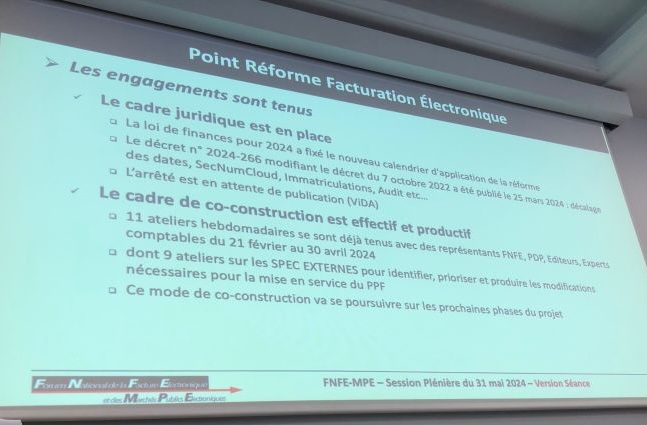
The General Assembly of the National Forum for Electronic Invoicing (FNFE) on May 31, 2024, provided an opportunity to review the progress of the electronic invoicing reform in France.
This meeting served to reiterate the project's key guidelines, clarify the next technical steps, and confirm the importance of collaboration among public stakeholders, platforms, software publishers, businesses, and dematerialization experts.
At that time, several questions were still circulating regarding the reform's timeline and implementation methods. The discussions served to reiterate that the widespread adoption of electronic invoicing remained a structuring project for French businesses.
Since then, the system has continued to evolve. The terminology PDP — Partner Dematerialization Platform has gradually given way to PA — Approved Platform, which now refers to platforms registered by the tax authorities.
In this article, we revisit the key takeaways from these discussions and the essential points for businesses preparing their transition to mandatory electronic invoicing.
To support this transition, ICD International offers DEMATRUST, its dedicated e-invoicing solution, as well as e-invoicing support to structure compliance projects.
A Gradually Stabilized Legal Framework
One of the first points discussed concerns the stabilization of the reform's legal framework.
Mandatory electronic invoicing is part of a profound transformation of exchanges between businesses and the tax authorities. It involves obligations for receiving, issuing, and transmitting data.
The legal framework has been progressively clarified to provide greater clarity to businesses and market players.
This stabilization is essential to enable:
- for businesses to prepare their processes;
- for software providers to adapt their solutions;
- for platforms to finalize their developments;
- for financial departments to structure their roadmap;
- for IT teams to anticipate necessary integrations;
- for partners to build interoperable solutions.
Therefore, the reform should not be approached solely as a tax matter. It should be treated as a cross-functional project, involving finance, accounting, IT, procurement, and sales teams.
ViDA: A European Framework Reinforcing Tax Digitalization
The work on the French reform is also part of a broader European context with the package ViDA — VAT in the Digital Age.
ViDA aims to modernize VAT at the European level, particularly through e-invoicing, digital reporting, and better harmonization of tax obligations.
During the 2024 discussions, ViDA's adoption was still pending. Since then, the package has been adopted at the European level, confirming the tax digitalization momentum underway in the European Union.
For international businesses, this development is significant. It shows that e-invoicing is not a French peculiarity, but a fundamental trend affecting an increasing number of countries.
Organizations must therefore anticipate not only the French reform but also the growing international e-compliance requirements.
The Publication of Technical Specifications
Another important point concerned the publication of external specifications.
These technical specifications describe the rules, formats, messages, statuses, and exchange procedures necessary for the system's operation.
They are essential for platforms, software providers, and businesses that need to prepare their information systems.
The specifications notably clarify:
- expected invoice formats;
- mandatory data;
- control rules;
- technical specifications;
- APIs;
- lifecycle statuses;
- directory interactions;
- inter-platform exchange methods.
For businesses, these elements might seem highly technical. However, they have concrete consequences for daily operations: data quality, status management, rejection processing, ERP integration, and invoice tracking.
The national directory: a central component of the system
The national electronic invoicing directory is one of the pillars of the reform.
Its role is to identify, for each company, the platform chosen to receive its electronic invoices.
It must enable invoices to be routed correctly to the right recipient and secure exchanges between businesses and platforms.
The directory must notably contain information related to:
- VAT-registered businesses;
- establishments;
- SIREN and SIRET identifiers;
- billing addresses;
- chosen reception platforms;
- relevant public entities.
For businesses, the quality of data in the directory will be crucial.
Incorrectly entered data can lead to routing errors, rejections, or processing delays.
This is why preparing customer and supplier master data should be among the first steps of the project.
Expected technical functionalities
The FNFE's work also highlighted several important functionalities for the successful implementation of the reform.
Key points highlighted include:
- simplifying directory-related flows;
- data historization;
- unique invoice identification;
- managing discrepancies and rounding;
- status tracking;
- redesigning the invoice lifecycle;
- improving controls;
- enhanced traceability of exchanges.
These functionalities are essential to ensure a smooth flow of electronic invoices between stakeholders.
They must also enable businesses to better track invoice processing, detect anomalies more quickly, and strengthen the management of their financial processes.
Invoice lifecycles: a major challenge for financial departments
Lifecycle management is one of the major changes brought about by e-invoicing.
Each invoice will no longer simply be issued or received. It will be tracked through various statuses, from its issuance to its final processing.
These statuses will indicate whether an invoice is:
- filed;
- transmitted;
- received;
- rejected;
- accepted;
- in dispute;
- sent for payment;
- paid.
For finance departments, this visibility is an important lever.
It enables better management of collections, reduces disputes, improves cash flow, and allows for more precise tracking of customer and supplier flows.
But this also requires adapting internal processes. Teams will need to know how to interpret statuses, handle rejections, and monitor anomalies in the tools used daily.
Interoperability between platforms: a key issue
The success of the reform also depends on interoperability between platforms.
Not all companies will choose the same Approved Platform. It is therefore essential that platforms can exchange information with each other in a fluid, reliable, and secure manner.
Interoperability must enable:
- the exchange of invoices between platforms;
- the transmission of statuses;
- the management of returns;
- data consistency;
- the continuity of flows;
- Traceability of transactions.
This topic is strategic, as poor interoperability can lead to operational bottlenecks: untransmitted invoices, unreceived statuses, processing errors, or loss of visibility.
PEPPOL: Towards Standardizing Exchanges
Efforts surrounding PEPPOL also played a significant role.
PEPPOL is a network and a set of standards used to facilitate electronic exchanges between businesses and public organizations.
As part of the French reform, the use of common standards can help strengthen interoperability, security, and the fluidity of exchanges.
The creation of a PEPPOL France authority aligns with this structuring approach.
For businesses, the challenge is to rely on solutions capable of managing current and future standards, while remaining compatible with French requirements.
ICD International is a certified PEPPOL Access Point and supports businesses in digitalization, EDI, and the automation of B2B exchanges.
From PDP to Approved Platform
During the FNFE General Assembly in 2024, the term widely used was still PDP — Partner Digitalization Platform.
Today, the official terminology is PA — Approved Platform.
An Approved Platform is an operator registered by the tax administration. It handles the issuance, reception, transmission, and processing of electronic invoices.
It also plays a key role in transmitting transaction and payment data to the administration.
An AP must meet several requirements:
- data security;
- interoperability;
- regulatory compliance;
- processing capacity;
- status management;
- traceability;
- integration with existing systems;
- support for business use cases.
You can view our full definition here: PA – Accredited Platform.
A project built with market players
The e-invoicing reform is not built solely by decree or technical specifications.
It also relies on continuous co-construction work with market players.
Workshops conducted with platforms, publishers, professional organizations, and industry experts help to better identify use cases, technical constraints, and the real needs of businesses.
This collaborative approach is essential, as invoicing flows vary significantly depending on sectors, company sizes, tools used, and internal organizations.
A successful reform must therefore take into account the diversity of situations encountered in the field.
What businesses need to prepare for now
For businesses, the lessons from this work are clear: the reform is progressing and requires structured preparation.
The priorities include the following:
- choosing an Accredited Platform;
- map customer and supplier flows;
- ensure the reliability of third-party data;
- identify specific use cases;
- analyze the impacts on the ERP;
- prepare accounting and finance teams;
- define validation workflows;
- anticipate status management;
- test data exchanges;
- establish project governance.
The choice of platform should not be made solely based on price or a technical promise.
It must be based on the solution's ability to meet the company's real needs, integrate into its existing environment, and support its business processes.
DEMATRUST: Supporting businesses through the reform
With DEMATRUST, ICD International assists companies in their transition to mandatory e-invoicing.
DEMATRUST enables centralizing, automating, and securing electronic invoice flows, while meeting the reform's compliance requirements.
The solution specifically allows for managing:
- receiving supplier invoices;
- issuing customer invoices;
- regulatory formats;
- mandatory data;
- lifecycle statuses;
- ERP integration;
- traceability of exchanges;
- the business needs of financial departments.
For VSEs and SMEs, ICD International also offers DEMATRUST Light, a solution designed to facilitate compliance with a simple and progressive approach.
Key takeaways
The FNFE General Assembly on May 31, 2024, served as a reminder of the major challenges of the electronic invoicing reform: framework stabilization, technical specifications, national directory, interoperability, PEPPOL, and collaboration among market players.
Since then, the project has continued to evolve, but the fundamentals remain the same: all companies must prepare to receive electronic invoices, and then to issue them according to the planned schedule.
The success of this transition will depend on the quality of preparation: platform selection, data reliability, flow mapping, IT integration, and team support.
Do you want to prepare your company for the electronic invoicing reform? Discover DEMATRUST or speak with our experts via our electronic invoicing supportpage.


